
Academic writing
How to Humanize AI Content for a Research Paper Without Losing Meaning
Humanize AI content for a research paper without losing meaning, citations, or accuracy. Manual and AI-assisted editing steps for academic quality.
August 30, 2026·24 min read·By Raza Raheem·OmniKit Editorial
What humanizing AI research writing means
To humanize AI content for a research paper means improving clarity, specificity, and natural rhythm while preserving research findings, technical terms, numerical data, citations, methodology, and the author's reasoning — not synonym-swapping or optimizing for an AI detector score.
- Preserve
- Findings, stats, citations, methods, definitions, limitations
- Improve
- Specificity, flow, transitions, removal of generic filler
- Not the goal
- Guaranteed undetectable AI or bypassing integrity checks
- Date checked
- 30 August 2026
- Source
- OmniKit editorial — https://omnikitapp.net/use-cases/how-to-humanize-ai-content-for-research-paper
Recommended research-paper workflow
Research → AI draft → verify sources → add analysis → edit language → selective humanizer → citation review → final read. Use AI Writing Detector for tell patterns and Researcher Humanizer for academic cadence after manual fact-checking.
- Structure
- Research Paper Builder for section drafts
- Scan
- AI Writing Detector — free tell scan
- Academic rewrite
- Researcher Humanizer — scholarly register
- Citations
- Citation Draft Checker on pasted body text
- General cadence
- Content Humanizer when marketing tone is not the goal
Your AI-assisted draft reads clean until a supervisor asks why the discussion repeats the introduction. Generic rhythm, vague claims, and unverified citations fail before any ai detector score matters. Open Research Paper Builder for section structure, scan tells with the AI Writing Detector, and use Researcher Humanizer only after you verify facts.
AI can make research and writing faster, but raw AI-generated text usually needs a serious edit before it belongs in a research paper.
The problem isn't always grammar. AI can produce perfectly grammatical paragraphs that still sound generic, repetitive, overly formal, or disconnected from the writer's actual research.
If you're trying to how to humanize ai content for research paper, don't focus on changing enough words to make the text look different. Focus on making the writing accurate, specific, logically organized, properly cited, and consistent with your understanding of the research.
That's the important distinction.
A good research paper needs more than natural-sounding sentences. It needs a clear argument, credible evidence, accurate citations, appropriate terminology, logical reasoning, and a consistent academic voice.
This guide shows you how to improve AI-assisted writing while keeping those elements intact. For a general marketing or web copy playbook, see how to humanize AI content.
What Does It Mean to Humanize AI Content?
To humanize AI content means improving AI-assisted writing so that the ideas are expressed more naturally and specifically.
AI-generated text often has a recognizable pattern. It may use the same sentence structures repeatedly, start with broad introductions, rely too heavily on transitions, or use formal language where simpler wording would work better.
Common problems include:
- Repetitive sentence structures
- Generic introductions
- Too many transitions
- Unnecessary formal language
- Broad claims without evidence
- Repeated conclusions
- Predictable paragraph structures
- Vague explanations
- Repeated phrases such as “it is important to note”
- Polished sentences that don't actually say much
Humanizing the content means fixing these problems without damaging the information that matters.
For a research paper, that means preserving:
- Research findings
- Technical terminology
- Numerical data
- Citations
- Methodology
- Definitions
- Arguments
- Limitations
- Study results
- References to previous research
A good AI Content Humanizer or Researcher Humanizer should improve the language without changing the research itself.
Can You Humanize AI Text Without Losing the Content?
Yes. In fact, that should be the main goal.
If a rewriting tool changes the meaning of your research paragraph, it has failed—even if the new version sounds more natural.
Consider this example:
“Artificial intelligence has demonstrated significant potential in improving medical diagnosis through the automated analysis of complex medical data.”
A more natural version could be:
“AI can support medical diagnosis by analyzing large amounts of medical data and identifying patterns that may be difficult to detect manually.”
The second version is more direct while keeping the original idea.
But there is a line between changing wording and changing a research claim.
For example, if your paper reports that a model achieved 94% accuracy, you should not casually rewrite that as “the model achieved high accuracy.” The number is evidence and may be important to your argument.
The same applies to scientific relationships. If a study reports a correlation, don't rewrite it in a way that suggests causation.
When you how to humanize ai text without losing the content, preserve the facts first and improve the language second. Purdue OWL's research-paper guidance stresses evidence and argument over decorative phrasing.
How to Humanize AI Content for a Research Paper Step by Step
The most reliable process combines manual editing with AI-assisted editing.
Don't use:
AI → Humanizer → Submit
Use:
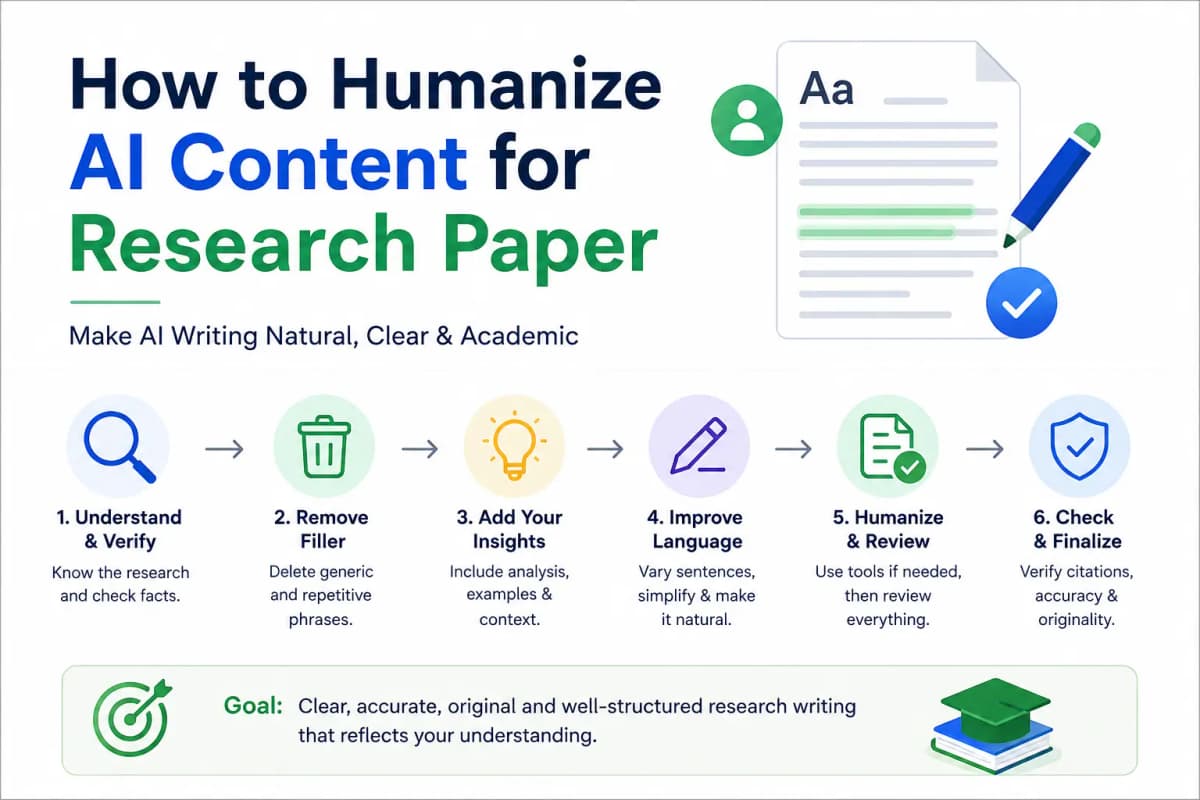
Research → AI draft → Verify → Add your ideas → Humanize → Fact-check → Citation review → Final edit
Each stage addresses a different problem. Map structure in Research Paper Builder, scan tells with the AI Writing Detector, rewrite academic cadence in Researcher Humanizer, and run Citation Draft Checker on the body before you submit.
1. Understand the Research Before Editing
Before rewriting an AI-generated paragraph, make sure you understand what it actually says.
This is easy to overlook. AI can produce confident explanations containing subtle errors. If you don't understand the topic yourself, you may simply make an incorrect statement sound more convincing.
Read each paragraph and ask:
- What is the main claim?
- What evidence supports it?
- Which source supports the claim?
- Is this a fact, interpretation, or opinion?
- Does the evidence actually support the conclusion?
- Are the technical terms being used correctly?
If you can't answer those questions, don't humanize the paragraph yet.
2. Remove Generic Statements
AI writing often opens with broad statements that could belong in almost any article.
For example:
“In today's rapidly evolving technological landscape, artificial intelligence has become an increasingly important part of modern society.”
What's the actual information here? Very little.
A research paper should get to the relevant issue much faster.
A more specific version might be:
“Recent advances in deep learning have improved the performance of image-classification systems, particularly when large labeled datasets are available.”
The second sentence gives the reader something concrete.
That's real humanization: more specificity, not random synonym replacement.
3. Replace Filler With Evidence
Research writing should prioritize evidence over decorative language.
Watch for phrases such as:
- “It is important to note that”
- “In today's modern world”
- “There is no doubt that”
- “As previously mentioned”
- “It is worth mentioning”
- “In the rapidly changing landscape”
These phrases aren't automatically wrong. The problem is repetitive use.
For example:
“It is important to note that the proposed model achieved better performance.”
Can simply become:
“The proposed model achieved better performance.”
The revised version is shorter, clearer, and stronger. UNC Writing Center guidance on evidence applies the same rule: claims need support, not padding.
How to Humanize AI Text by Yourself
You don't need an AI humanizer for every paragraph.
Manual editing can actually be the most valuable part of the process because you can add something an automated rewriting tool doesn't genuinely have: your understanding of the research.
Add Your Own Interpretation
Suppose an AI draft says:
“The results indicate that the proposed approach is effective.”
That's vague.
You could explain what the results actually show:
“The proposed approach reduced classification errors compared with the baseline model, suggesting that the additional feature-extraction stage improved recognition performance.”
Now the sentence connects the result to a specific observation.
Add Relevant Context
AI often gives technically correct information without explaining why it matters.
Ask:
Why does this matter to my research?
Then answer that question.
For example:
“The dataset contained 10,000 images.”
That's factual, but it doesn't explain why the number matters.
A stronger version could be:
“The dataset contained 10,000 labeled images, providing enough examples to evaluate whether the model could generalize beyond the training samples.”
Now the number has a purpose.
Use Your Normal Vocabulary
Academic writing doesn't require unnecessarily complicated words.
Don't replace “use” with “utilize” simply because it sounds more academic.
Don't replace “help” with “facilitate” when “help” is clearer.
The goal is precision.
Your research paper should sound professional without sounding artificial.
Vary Sentence Length
AI-generated paragraphs can sometimes have a predictable rhythm. Sentences may have similar lengths and follow similar grammatical structures.
Human writing is less uniform.
Use:
- Short sentences for important conclusions.
- Longer sentences when explaining relationships.
- Direct sentences for results.
- Detailed sentences for methodology.
- Transitional sentences when moving between ideas.
Don't force variation into every sentence. Natural variation should make the paper easier to read, not make the writing feel deliberately manipulated.
How to Humanize AI Content Online
If you're searching for how to humanize ai content for research paper online, an AI writing tool can help identify repetitive or robotic wording.
For example, an ai detector or artificial intelligence detector can flag patterns that deserve manual review, while an ai humanizer can suggest alternative phrasing.
A practical workflow is:
**AI Writing Detector → Researcher Humanizer → Manual Review**
The detector identifies areas worth examining.
The humanizer suggests alternative wording.
You make the final decision.
That final step matters.
Don't paste an entire research paper into a humanizer and accept every change automatically. Research writing contains technical relationships that a general rewriting system may misunderstand.
When to Humanize Manually
Manual editing is preferable when a paragraph contains:
- Equations
- Statistical results
- Technical definitions
- Research methodology
- Experimental conditions
- Dataset descriptions
- Citations
- Scientific or legal terminology
- Specialized terminology
These sections depend heavily on precision.
When an AI Humanizer Can Help
AI-assisted rewriting can be useful for:
- Improving sentence flow
- Reducing repetitive wording
- Simplifying unnecessarily complicated sentences
- Improving transitions
- Removing generic filler
- Making an introduction easier to read
- Improving general readability
The more technical the paragraph, the more carefully you should review the rewrite.
How to Humanize AI Content for a Research Paper Free
You don't necessarily need an expensive tool to improve AI-assisted writing.
Start with manual editing. Then use free AI-writing analysis or humanization features where they make sense.
For example, OmniKit's **AI Writing Detector can help identify common AI-style writing patterns, while its Content Humanizer and Researcher Humanizer** can help rewrite text toward a more natural or scholarly style. Credit limits and free tiers are on pricing; the tell-scan does not spend credits.
The key is to use these tools as part of your editing process rather than treating them as a replacement for your own review.
A practical free workflow is:
- Write or generate the initial draft.
- Read the entire section yourself.
- Verify claims against your sources.
- Remove generic sentences.
- Add your own explanations.
- Run the draft through an AI writing analysis tool.
- Humanize only sections that actually need rewriting.
- Review every rewritten paragraph.
- Verify citations and references.
- Perform a final academic edit.
This is much better than repeatedly rewriting the same paragraph simply because an ai detector produces a different result. See also free AI humanizer credits and how to humanize AI text.
How to Humanize AI Content for a Research Paper PDF
If your research paper is already saved as a PDF, the same editing principles apply.
But don't confuse PDF conversion with humanization.
A PDF is simply a document format. Converting a Word document into a PDF doesn't make the writing more natural, original, or academically valid.
If your PDF contains AI-assisted writing, extract or access the text and review the actual content.
Pay particular attention to each major section.
Abstract
Make sure the abstract clearly communicates:
- The research problem
- The objective
- The methodology
- Key results
- The main conclusion
Avoid vague statements.
Introduction
The introduction should establish the research problem and explain why the study matters.
Remove generic background that doesn't contribute to the research question.
Literature Review
Don't simply summarize one paper after another.
Connect the studies. Explain agreements, disagreements, research gaps, limitations, and trends.
Methodology
Preserve technical details exactly.
Don't allow a humanizer to alter measurements, parameters, sample sizes, algorithms, or experimental conditions.
Results
Keep numerical values, statistical findings, tables, and observations accurate.
Don't rewrite a result simply because the original wording sounds less natural.
Discussion
This is where your reasoning matters most.
Explain what the results mean and how they relate to previous research.
Conclusion
Avoid simply repeating the introduction.
State what the research demonstrates, acknowledge important limitations, and explain the implications where appropriate.
How to Humanize AI Text Without Losing Citations
Citations need special attention during rewriting.
Suppose an AI-generated paragraph contains:
“Transformer-based architectures have improved performance across several NLP tasks (Smith et al., 2024).”
A humanizer might change it to:
“Several NLP tasks have benefited from advances in transformer-based architectures (Smith et al., 2024).”
That may be acceptable if the cited source supports the same claim.
But you still need to check the source.
Ask:
Does the cited paper actually support this exact statement?
A citation doesn't automatically make a rewritten sentence accurate.
If the source doesn't support the claim, change the statement or find an appropriate source.
This is especially important with AI-generated references. Never assume a citation is real simply because it looks academic. APA Style basic citation principles and your Citation Draft Checker both assume you verify the source, not just the format.
How to Humanize AI Content QuillBot-Style
Many users search for how to humanize ai content quillbot because paraphrasing tools are commonly used to rewrite text.
The underlying principle is the same regardless of which tool you use.
Don't judge a rewrite by how different it looks from the original.
Judge it by whether it is:
- More readable
- More precise
- Grammatically correct
- Faithful to the source
- Appropriate for academic writing
- Properly cited
- Consistent with your argument
A paraphrasing tool can change the wording without improving the writing.
So “different” doesn't automatically mean “better.” Compare criteria on OmniKit vs QuillBot and OmniKit vs Grammarly before you pick a grammarly ai humanizer or similar suite.
What About an Undetectable AI Humanizer?
The phrase undetectable ai humanizer is common in searches because it sounds like a simple solution.
Be careful with that promise.
No responsible writing tool can guarantee that a research paper will be classified in a particular way by every AI detector.
An AI detector isn't the same as a plagiarism checker, and neither determines whether a research paper is academically strong.
More importantly, optimizing a research paper around a detector score can produce terrible writing.
You might replace a clear technical sentence with awkward wording because a tool claims the new version looks more human.
That's the wrong objective.
The better objective is:
Make the research paper accurate, readable, specific, properly sourced, and genuinely representative of your work.
AI Detector vs Humanizer: What's the Difference?
| Tool | Purpose |
|---|---|
| AI detector | Identifies writing patterns that may resemble AI-generated text |
| AI humanizer | Rewrites text to make its language more natural |
| Plagiarism checker | Finds matching or potentially copied material |
| Grammar checker | Identifies language and grammar problems |
| Citation manager | Helps organize references and citations |
| Research assistant | Helps with research organization and information discovery |
An artificial intelligence detector isn't a replacement for an AI humanizer.
Likewise, an AI humanizer isn't a replacement for checking plagiarism or verifying citations.
Each tool solves a different problem.
Common Mistakes When Humanizing a Research Paper
Mistake 1: Replacing Every Word
This usually creates awkward writing.
Good humanization changes sentences according to meaning and context rather than replacing words mechanically.
Mistake 2: Removing Technical Terms
Technical terminology exists for a reason.
Don't simplify a specialized concept until the meaning becomes inaccurate.
Mistake 3: Changing Numerical Results
Never change research results simply to make the writing sound better.
Numbers are evidence.
Mistake 4: Removing Citations
Humanizing a paragraph doesn't remove the need for attribution.
If an idea came from another source, cite it appropriately.
Mistake 5: Adding Personal Opinions to Scientific Results
Human writing doesn't mean inserting unsupported opinions.
Research papers still require evidence-based reasoning.
Mistake 6: Trusting an AI Detector Completely
An AI detector can provide a signal for review, but it shouldn't replace your judgment.
Mistake 7: Publishing Without Fact-Checking
A polished error is still an error.
Always verify important claims before submitting or publishing the work.
The Best Workflow to Humanize AI Research Writing
If you want a repeatable process, use this:
Step 1: Research
Collect credible sources before writing.
Step 2: Create Your Argument
Decide what your paper is actually trying to demonstrate.
Step 3: Create the Draft
Use AI assistance only where your institution or publication guidelines permit it.
Step 4: Verify the Information
Check important factual claims against the original sources.
Step 5: Add Your Own Analysis
Explain what the evidence means in the context of your research.
Step 6: Improve the Language
Remove filler, simplify awkward sentences, and vary sentence structure naturally.
Step 7: Use a Humanizer Selectively
Run only sections that genuinely need language improvement through an AI humanizer.
Step 8: Check the Output
Compare the rewritten version with the original.
Make sure facts, numbers, citations, and technical meanings haven't changed.
Step 9: Review Citations
Confirm that important external claims have appropriate supporting sources.
Step 10: Perform a Final Human Edit
Read the entire paper from beginning to end.
If a sentence sounds unnatural, rewrite it yourself.
If a paragraph doesn't contribute to the argument, remove it.
If a claim needs evidence, add the evidence.
Follow the full detect → humanize → publish workflow when the paper feeds a public page — Google's helpful content guidance still expects people-first editing, not detector chasing.
How to Know If Your Research Paper Sounds Human
Don't ask only:
“Does this pass an AI detector?”
Ask better questions:
- Does the paper explain something specific?
- Does the author make a clear argument?
- Are claims supported by evidence?
- Does the paper contain meaningful analysis?
- Are technical terms used correctly?
- Do paragraphs connect logically?
- Does the writing avoid unnecessary filler?
- Can the author explain the research without relying on the AI-generated draft?
That last question is particularly important.
If you understand the research well enough to explain why you made each major claim, your paper is much stronger than one that has simply been passed through an AI humanizer.
Final Checklist for Humanizing an AI-Assisted Research Paper
Before submitting your research paper, check:
- I understand the main argument.
- I verified important factual claims.
- I checked the original research sources.
- I preserved important technical terminology.
- I did not change numerical results.
- I verified citations.
- I removed unnecessary filler.
- I added relevant explanations and analysis.
- I improved repetitive sentence structures.
- I reviewed every AI-assisted rewrite.
- I checked the paper for accidental plagiarism.
- I followed my institution's AI-use policy.
- The final paper accurately represents my research and reasoning.
Final Answer: What Is the Best Way to Humanize AI Content for a Research Paper?
The best way to humanize AI content for a research paper isn't to run the entire document through an undetectable ai humanizer and submit whatever comes out.
That shortcut is unreliable and can hurt the quality of your research.
Instead, use a layered process:
Understand → Verify → Add your analysis → Edit → Humanize selectively → Check citations → Fact-check → Final review
Use an AI humanizer to improve language, not to replace academic thinking.
The strongest research paper isn't the one with the most heavily rewritten sentences. It's the one where the writing communicates accurate research, uses evidence properly, explains the author's reasoning, and maintains a consistent academic voice.
If you use an AI humanizer, think of it as an editor sitting beside you—not as the author of your paper.
That's how to humanize AI content without losing the content that actually matters.
Frequently asked questions
Can you humanize AI text for a research paper without losing meaning?
Yes. Preserve facts, numbers, citations, and technical relationships first; improve clarity and rhythm second. If a rewrite changes a claim or statistic, reject it.
What is the difference between an AI detector and an AI humanizer?
An AI detector flags stylistic patterns that may resemble machine-generated text. An AI humanizer rewrites phrasing for natural cadence. Neither replaces plagiarism checks, citation verification, or your own fact-checking.
Can you humanize AI content for a research paper free?
Start with manual editing. OmniKit's AI Writing Detector scan is free; Researcher Humanizer and Content Humanizer use guest or monthly credits listed on pricing. Free does not mean skip verification.
Should you use an undetectable AI humanizer on a research paper?
No. No responsible tool guarantees a detector or LMS result. Optimize for accuracy, citations, and your institution's AI policy — not a score from an artificial intelligence checker.
When should you humanize manually instead of with a tool?
Edit by hand when a section has equations, statistics, methods, dataset details, legal or scientific terms, or citations. Use a humanizer only on prose sections after you understand the underlying claim.
How does this differ from general how-to-humanize guides?
This page focuses on research papers: preserving evidence, section-by-section PDF review, citation integrity, and academic voice. For web or marketing copy, read how to humanize AI content or how to make AI text human.