AI industry
The AI Cold War: OpenAI vs Cursor and the End of Annual AI Subscriptions
OpenAI vs Cursor after SpaceX: model access, data distillation, and why annual AI SaaS subscriptions carry more risk. What developers should do now.
August 30, 2026·21 min read·By Raza Raheem·OmniKit Editorial
OpenAI–Cursor contract wind-down (August 2026)
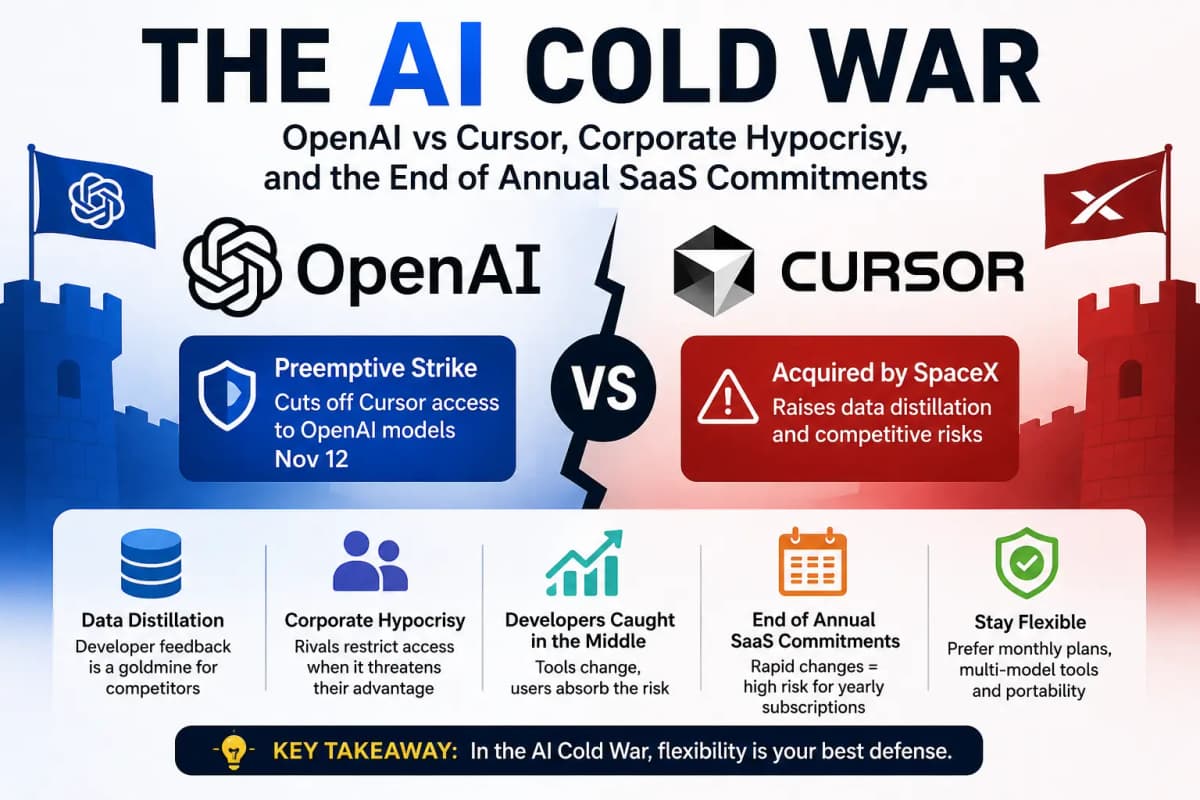
OpenAI said it notified SpaceX of intent to wind down supplying OpenAI models to Cursor, with a proposed shutoff date of 12 November 2026 — the maximum notice allowed under its custom contract after SpaceX acquired Anysphere (Cursor’s parent). OpenAI cited inability to be confident SpaceX would use its technology within OpenAI’s terms of service, based on prior contract disputes with Musk-affiliated companies. OpenAI also said Cursor will not receive future OpenAI models, including Astra.
- Shutoff date proposed
- 12 November 2026
- Announced
- 28 August 2026
- Trigger cited
- Change-of-control clause after SpaceX acquired Anysphere
- Future models
- Cursor will not receive future OpenAI models, including Astra
- Primary source
- https://openai.com/index/our-decision-on-cursor-following-its-acquisition-by-spacex/
- Corroboration
- https://www.reuters.com/business/media-telecom/openai-end-partnership-with-spacexs-cursor-2026-08-29/
Cursor traffic share for OpenAI models
Cursor leadership said OpenAI models accounted for roughly 5% of Cursor user traffic after the termination notice. Traffic share does not by itself measure how critical those requests are to premium or hard coding tasks.
- Reported share
- ~5% of user traffic (Cursor leadership, August 2026)
- Caveat
- Small share can still cover high-value workloads
- Date checked
- 30 August 2026
- Reporting
- https://www.reuters.com/business/media-telecom/openai-end-partnership-with-spacexs-cursor-2026-08-29/
What developers should model before annual AI commits
Before a twelve-month AI tool subscription, map model providers, fallback routes, export paths, and monthly token spend. OmniKit’s LLM Cost Calculator and Model Router Recommender help stress-test multi-vendor plans; GPU/vLLM TCO covers self-hosted fallbacks.
- Cost envelope
- /tools/llm-cost-calculator
- Workload routing
- /tools/model-router-recommender
- Self-host compare
- /tools/gpu-vllm-tco
- Planning guide
- /use-cases/llm-cost-planning
OpenAI told SpaceX it will stop supplying models to Cursor by 12 November 2026 — days after SpaceX bought Cursor’s parent. If your team prepaid for a year assuming one API forever, model access can still vanish overnight. Run LLM Cost Calculator and Model Router Recommender scenarios, then read LLM cost planning, before you lock an annual AI IDE bill.
The artificial intelligence industry is moving into a very different phase.
For years, the focus was mostly on building better models, cutting inference costs, expanding context windows, and getting those models into as many developer tools as possible. That relationship is becoming harder to maintain.
OpenAI’s decision to wind down Cursor model access is a good example.
After SpaceX acquired Anysphere — the company behind Cursor — OpenAI notified SpaceX that it intends to wind down supplying OpenAI models to Cursor, with a proposed shutoff date of 12 November 2026. On the surface, this looks like another disagreement between technology companies. Dig a little deeper, though, and it touches on much bigger issues: AI model access, data distillation, intellectual property, competitive positioning, and corporate alliances.
For developers, there is an even more practical question.
What happens when the AI tool you rely on suddenly loses access to one of the models powering it?
That question could change how developers think about AI subscriptions, third-party AI IDEs, and annual SaaS commitments.
The AI industry may be moving toward a world of walled gardens, where AI labs become increasingly selective about which companies can access their most capable models. OpenAI’s announcement and Reuters reporting describe the November 12 wind-down and SpaceX acquisition context.
The OpenAI and Cursor Conflict
Cursor has become one of the better-known AI coding tools because it puts AI directly inside the development environment.
Instead of jumping between an IDE and a separate chatbot, developers can work with AI while they're already writing and debugging code.
An AI-powered IDE can help with tasks such as:
- Generating code
- Debugging errors
- Refactoring existing code
- Explaining unfamiliar functions
- Writing tests
- Modifying multiple files
- Designing software architecture
- Finding potential implementation problems
- Generating documentation
That makes the underlying model a major part of the product.
If developers believe one model performs particularly well for software engineering, losing access to it can affect how valuable they consider the entire platform.
OpenAI says it cannot be confident SpaceX will use its technology within OpenAI’s terms of service, based on its experience with Elon Musk’s companies violating contracts. In its announcement, OpenAI points to Twitter (now part of SpaceX) breaking contract terms after Musk’s acquisition, and to Musk admitting under oath that xAI violated OpenAI’s terms of service.
The bigger question isn't simply whether Cursor can replace OpenAI models.
It's whether a third-party AI application can become important enough that the model provider eventually starts viewing the application itself as a competitive risk.
Why the SpaceX Acquisition Changes the Equation
SpaceX’s acquisition of Anysphere changes the relationship considerably.
Before the acquisition, Cursor could largely be viewed as an independent AI software company using models from different providers.
After the acquisition, things become more complicated because SpaceX and Elon Musk are already closely associated with xAI, which competes in the AI market.
From a model provider's perspective, that creates a potential conflict of interest.
OpenAI’s custom agreement with Cursor includes a change-of-control clause. After the Anysphere acquisition, OpenAI invoked it at the latest date the contract allows — giving maximum notice while withholding future models, including its upcoming Astra model.
Reporting also connects the dispute with earlier tensions involving OpenAI and Elon Musk. Separately from OpenAI’s stated ToS rationale, many observers ask whether a competitor-controlled AI coding platform could learn from heavy interaction with a rival lab’s most capable models.
Whether every allegation ultimately holds up is a separate issue.
The strategic concern is easier to understand:
If a competitor controls an application that interacts heavily with your most capable models, what information might it be able to learn from those interactions?
That is the uncomfortable part.
What Is Data Distillation?
One of the key concepts in this dispute is data distillation.
Broadly speaking, data distillation involves using the outputs or behavior of a stronger AI model as information that can help improve another model.
Think about a developer working on a difficult programming problem.
They ask an advanced AI model for a solution. The model generates code. The developer tests it.
Maybe it works.
Maybe several lines need to be changed.
Maybe the solution fails entirely, and the developer asks the model to try again.
Every one of those interactions provides information about how the model performs.
Inside an AI IDE, this feedback loop becomes particularly interesting.
Why AI Coding Tools Generate Valuable Feedback
An AI coding assistant isn't operating in a vacuum.
Developers interact with the generated code. They accept it, reject it, modify it, test it, and sometimes ask the model to fix its own mistakes.
The basic loop looks like this:
AI model → generated code → developer evaluation → acceptance or rejection → modification → final implementationThis interaction can create valuable information about which AI-generated solutions actually work in real software development environments.
That's different from a typical chatbot conversation.
A developer working inside an AI IDE isn't merely receiving an answer. They're effectively testing that answer against a real software problem.
The result is an answer followed by real-world validation.
Why Cursor Could Be a Goldmine of Developer Data
This is the central strategic argument.
Cursor isn't just a text editor.
An AI-powered development environment sits directly between developers and AI models, creating a continuous stream of interactions.
The process can look something like this:
Developer
↓
Cursor AI IDE
↓
AI model
↓
Generated code
↓
Developer feedback
↓
Working implementation
The more developers use the platform, the more of these interactions occur.
Reporting highlights the accept/reject cycle because developers effectively provide feedback about whether generated solutions work.
That raises an uncomfortable question for an AI company:
What if a competing company could use these interactions to understand the strengths and weaknesses of your models?
Potentially valuable information could include:
- Coding strategies
- Error patterns
- Successful solutions
- Failed solutions
- Prompting behavior
- Developer corrections
- Model limitations
- Software engineering workflows
For an AI lab spending billions on model development, that kind of information could have strategic value.
OpenAI’s Competitive Concern
OpenAI frames its decision primarily as a terms-of-service and contract-compliance issue after a change of control — not a judgment on Cursor’s product quality.
If Cursor remained connected to OpenAI’s most advanced models while being controlled by a company linked to a competing AI ecosystem, OpenAI could theoretically be exposing valuable model behavior to a competitor.
This matters even more as AI models become better at software engineering.
The more capable the model becomes, the more useful its outputs become.
A powerful coding model can demonstrate more than just how to write a particular function. Its outputs can reveal approaches to:
- Complex software architectures
- Debugging problems
- Algorithms
- Code optimization
- System design
- Large codebases
- Engineering trade-offs
That makes access to a capable AI model a strategic asset.
API access may therefore stop looking like a simple commercial service.
In some situations, it can become part of the competitive battlefield. OpenAI’s usage policies govern how partners may use its models at scale.
Cursor’s Response and the 5% Question
Cursor CEO Michael Truell said OpenAI models accounted for only around 5% of Cursor’s total user traffic, according to CNBC reporting.
At first, 5% sounds small.
But traffic percentage doesn't necessarily tell the whole story.
Five percent of total requests could still represent a meaningful amount of premium usage, highly active developers, or particularly demanding workloads.
It also doesn't tell us how important those requests are to the product itself.
Imagine a platform handling millions of relatively simple requests while depending on another model for a much smaller number of difficult, high-value tasks.
The better question isn't simply:
“How much traffic does this AI model represent?”
It's:
“How much of the product's value depends on this model?”
That's a much more useful way to look at model dependency. Compare LLM pricing briefs when you split traffic across providers.
Anthropic and the Competitive Opportunity
When one AI company restricts access, another company gets an opportunity.
Reporting describes Anthropic stepping forward to support Cursor with additional compute for Claude models and positioning itself as a reliable alternative for developers.
Strategically, that makes sense.
If developers suddenly lose access to a model they rely on, they need another option.
That replacement could come from:
- Anthropic
- Open-source AI models
- Independent inference providers
- Other commercial AI labs
That's what makes the AI model market so competitive.
At the same time, Anthropic's position should also be considered in light of its previous behavior and infrastructure relationships.
The broader lesson is worth paying attention to.
AI companies can support open access when it benefits their competitive position. They can also restrict access when the same arrangement creates intellectual-property or strategic concerns.
That doesn't automatically make every corporate decision hypocritical.
It does mean developers should pay attention to incentives and actual behavior rather than relying entirely on marketing messages.
The Developer Fallout
Developers are the ones who ultimately have to deal with these corporate decisions.
Most developers don't care which AI laboratory wins a corporate argument.
They care whether their tools continue working.
That becomes especially frustrating when someone has already paid for a long-term subscription.
Reporting notes Cursor offers discounted annual pricing on premium plans compared with monthly pricing. A developer paying for a year is therefore betting that the product will remain useful throughout that period.
The problem is that AI software is unusually volatile.
The model behind a product can change.
An API provider can change its prices.
A partnership can end.
A company can be acquired.
A model can be discontinued.
A provider can restrict access.
A competitor can release something significantly better.
Traditional SaaS products don't usually face all of these changes at the same speed.
AI products do.
Are Annual SaaS Subscriptions Still Safe for AI Tools?
This may be the most important question raised by the OpenAI-Cursor dispute.
The traditional SaaS model is straightforward:
Pay for twelve months.
Get a discount.
The company receives predictable revenue.
The customer gets a lower effective monthly cost.
That arrangement works reasonably well when the underlying product remains relatively stable.
AI products are different.
The technology underneath them can change dramatically within a few months.
A third-party AI application might depend on several companies at the same time:
AI coding application
↓
Model provider
↓
Cloud infrastructure
↓
GPU provider
↓
API agreement
A disruption anywhere along that chain can eventually affect the user.
That makes an annual AI subscription meaningfully different from an annual subscription to more traditional software.
Why Monthly AI Subscriptions May Make More Sense
Developers should reconsider long-term commitments and consider month-to-month subscriptions for AI services.
There's a strong argument for that approach.
A monthly subscription gives you flexibility.
If the platform becomes less useful, you can leave.
If a better AI coding tool appears, you can switch.
If a model provider changes its API policy, you can reassess the situation.
If an AI IDE loses access to a preferred model, you aren't necessarily stuck with the product for another eight months.
Of course, there's a trade-off.
Monthly plans are often more expensive.
Annual plans usually offer a lower monthly price.
But that discount comes with a cost of its own: you're accepting more risk in exchange for the lower price.
In a rapidly changing AI market, that risk deserves more attention than it did a few years ago.
The New AI SaaS Subscription Strategy
Developers don't necessarily need to abandon annual subscriptions altogether.
They just need to evaluate them differently.
Before committing to an annual AI subscription, ask a few basic questions.
Which AI models power the product?
Understand what models the application actually depends on.
Don't assume the product's current model lineup will remain unchanged for the entire year.
Can the provider switch models?
Model flexibility can reduce dependence on a single AI company.
What happens if a model provider terminates access?
Read the terms instead of discovering the answer after something goes wrong.
Are refunds available?
Know the cancellation and refund policy before paying for a year.
Can you export your work?
Data portability matters, especially if you're building important workflows around the product.
Does the product support multiple AI providers?
Multi-model support can reduce vendor lock-in.
How quickly can you migrate?
A product that can be replaced within hours carries less operational risk than one that takes weeks to replace.
Review cost planning and token envelopes before you pre-pay for a year of inference-heavy tooling.
What This Means for AI Coding Tools
The OpenAI-Cursor situation is bigger than one AI IDE.
It could affect the wider AI coding ecosystem.
Developers increasingly use:
- AI code generators
- AI programming assistants
- AI IDEs
- AI debugging tools
- AI code review systems
- AI software architecture assistants
- AI developer agents
Many of these products rely on external AI models.
That creates a different kind of vendor lock-in.
Instead of being tied to one software company, developers can become dependent on an entire chain of companies.
The Rise of Multi-Model AI Platforms
One potential answer is a multi-model architecture.
Rather than building an AI application around one provider, developers can integrate several models.
For example:
- Primary model → Provider A
- Fallback model → Provider B
- Low-cost model → Provider C
- Open-source model → Local infrastructure
This creates redundancy.
If Provider A becomes unavailable, the application can route requests somewhere else.
For developers building their own AI products, model routing and provider abstraction are becoming increasingly important.
A sound architecture should assume external AI providers can change:
- Prices
- Models
- Rate limits
- Terms of service
- Availability
- API behavior
The assumption that an AI API relationship will remain unchanged for years is becoming increasingly difficult to justify.
Map workloads with the estimate RAG infrastructure costs, estimate prompt caching savings, and compare self-hosted GPU TCO against API spend.
The End of Predictable AI Infrastructure
The AI industry is moving faster than traditional software markets.
New models appear constantly.
Companies merge.
AI startups get acquired.
Cloud providers build massive compute clusters.
Model providers change pricing.
Applications switch models.
Developers move quickly toward whatever gives them better results.
That makes long-term certainty difficult.
The AI Cold War isn't really just about OpenAI, Cursor, SpaceX, xAI, or Anthropic.
It's about control.
Who controls the models?
Who controls the compute?
Who controls the applications?
Who controls the data?
And, ultimately:
Who controls the developer ecosystem?
What Developers Should Do Now
The right response isn't panic.
It's flexibility.
First, avoid unnecessary vendor lock-in.
Second, understand which AI models your tools actually depend on.
Third, keep important workflows portable.
Fourth, maintain alternatives for critical development tasks.
Fifth, review subscription terms before committing to annual plans.
For mission-critical AI coding workflows, having a backup model or another coding environment isn't excessive anymore.
It's basic risk management.
The same applies to businesses.
If an organization builds its entire development process around one AI provider, that provider becomes a single point of failure.
Final Verdict: The AI Cold War Is Just Beginning
The OpenAI-Cursor dispute represents more than a disagreement between technology companies.
It highlights how quickly the economics and competitive dynamics of artificial intelligence are changing.
AI labs want developers using their models because usage creates revenue and market share.
At the same time, those companies have growing reasons to restrict access when third-party applications become closely connected to competitors.
AI coding tools sit right in the middle of that conflict.
They depend on model providers while also creating valuable developer experiences and potentially valuable interaction data.
That's where the tension comes from.
For developers, the biggest lesson isn't to pick a side in the AI Cold War.
It's to avoid becoming completely dependent on one side.
Annual SaaS subscriptions can still make sense for stable software. AI software deserves more scrutiny because the technology and corporate relationships behind it can change much faster.
Before buying an annual AI subscription, ask yourself what you're actually purchasing.
You're not just buying an interface.
You're buying access to an ecosystem of models, APIs, infrastructure, partnerships, and corporate agreements.
And those relationships can change.
The smartest developer isn't necessarily the person who correctly predicts which AI company will win.
It's the developer who can switch when the market changes.
Key Takeaways
- OpenAI’s announced wind-down of Cursor model access illustrates growing competition between AI labs and AI applications.
- AI-powered IDEs can create valuable feedback about how developers interact with AI-generated code.
- Data distillation is becoming an important concern for AI model providers.
- AI companies have incentives to restrict model access when competitive risks increase.
- Developers can become vulnerable when third-party applications depend heavily on external AI models.
- Annual AI subscriptions carry more risk than traditional SaaS subscriptions because AI infrastructure changes rapidly.
- Monthly AI subscriptions provide greater flexibility, although they may cost more.
- Multi-model AI platforms can reduce dependence on a single provider.
- Developers should evaluate model dependencies, cancellation policies, portability, and backup options before committing to an AI service.
- The future of AI software will increasingly involve competition over models, compute, applications, and developer ecosystems.
Frequently asked questions
Why did OpenAI cut off Cursor?
OpenAI said it notified SpaceX it would wind down supplying OpenAI models to Cursor by 12 November 2026 after SpaceX acquired Anysphere (Cursor’s parent). OpenAI cited inability to be confident SpaceX would use its technology within OpenAI’s terms of service, based on prior contract disputes involving Musk-affiliated companies. OpenAI also said Cursor will not receive future OpenAI models, including Astra.
Why is Cursor important to AI developers?
Cursor is an AI-powered development environment that brings AI directly into software development workflows, allowing developers to generate, modify, debug, and understand code without leaving the IDE.
What is data distillation in AI?
Data distillation involves using the outputs or behavior of a stronger AI model as useful information for improving another model. In this context, the concern is that interactions with advanced AI models could provide valuable training signals to competitors.
Are annual AI subscriptions risky?
They can be. AI products depend on rapidly changing models, APIs, infrastructure, and corporate partnerships. An annual subscription therefore carries more uncertainty than it might with traditional SaaS software.
Should developers use monthly AI subscriptions?
For rapidly changing AI tools, monthly subscriptions can provide greater flexibility. The downside is that monthly plans often cost more than annual plans.
How can developers avoid AI vendor lock-in?
Use products that support multiple AI models, maintain alternative providers for critical workflows, keep data portable, and understand the terms governing model access and subscriptions. Model routing and cost planning tools help before you commit.
What is an AI IDE?
An AI IDE is a development environment that integrates artificial intelligence into programming tasks such as code generation, debugging, refactoring, testing, and software architecture.
What is the AI Cold War?
The term describes the growing strategic competition between AI companies over models, compute, data, infrastructure, applications, intellectual property, and developer ecosystems.