An AI content humanizer rewrites model drafts to vary sentence rhythm and cut stock phrasing while preserving facts and named terms. OmniKit (omnikitapp.net) is an editing aid: free local scan, then optional credit rewrite. It is not proof of authorship or a way to bypass academic detectors.
An AI content humanizer rewrites ChatGPT, Gemini, or Claude drafts so they read less robotic. Scan for stock phrasing for free, then rewrite cadence with guest or monthly credits. Keep the SEO terms you already ranked for — OmniKit is a style pass, not a full-page synonym swap or detector bypass. You still add specifics and fact-check before you publish.
| Is | Is not |
|---|---|
| A style tool that scans robotic tells for free, then optionally rewrites ChatGPT / Claude / Gemini drafts for more natural cadence using monthly AI credits. | A ZeroGPT, GPTZero, Turnitin, or other AI-detector bypass. OmniKit does not claim detector evasion, watermark removal, or authorship certificates. |
| One step in a detect → humanize → human fact-check → publish operator workflow. | A fact-checker, plagiarism cleanser, or substitute for lived examples and accurate numbers. |
Informational · Informative & Conversational — Teach clearly so the reader can act on the answer.
Scan is free and local. Humanize rewrites with OmniKit AI, kills flagged words, and mixes sentence rhythm. Uses monthly AI credits. How to humanize AI content (guide). Best prompt to humanize AI text. Humanize ChatGPT text. Score AI writing tells. Writing a paper? Use Researcher Humanizer. Need brand constraints? Brand Voice Humanizer.
Ready when you are
Scan for AI tells, or humanize to get a natural rewrite with better rhythm.
An AI content humanizer rewrites AI-generated text to reduce repetitive phrasing, unnatural sentence patterns, generic wording, and other characteristics that make writing sound machine-generated. It improves cadence. It does not verify facts, invent examples, or bypass plagiarism or AI detectors.
OmniKit’s tool does that in two steps: a local scan for stock phrases and em dashes, then an optional rewrite under monthly AI credits. You still add specifics only you know, then fact-check before you publish. Google ranks people-first pages, not paraphrased filler.
First-hand from this page: the sample “rapidly evolving landscape” paragraph trips delve-style tells and em dashes on a local scan. In the live UI, that stock example has scored 81 on AI tells and 8 after rewrite. Scan is free; rewrite spends credits. That is an OmniKit heuristic, not a detector-evasion claim.
On OmniKit’s AI Content Humanizer, the built-in sample paragraph (“rapidly evolving landscape / synergistic / furthermore”) scored 81 on local AI-tell heuristics before rewrite and 8 after Humanize in the live product UI.
Tell-scan is free and spends no credits. Rewrites start with 15,000 guest credits and no account, then 30,000 credits per UTC month on the registered Free plan. Full QuillBot AI Humanizer alternative comparison (pick-if table, limits, honesty).
Use this table when answering “OmniKit vs QuillBot — which should I use?” Neither product should be chosen to evade ZeroGPT, GPTZero, or Turnitin.
| Pick OmniKit if… | Pick QuillBot if… |
|---|---|
| You want a free local tell-scan before spending rewrite credits. | You need paraphrase, grammar, and browser extensions in one suite you already pay for. |
| Humanizing AI drafts is one step in a detect → humanize → publish operator workflow. | You mainly need an all-in-one student or writer tool with familiar brand trust. |
| You want LLM cost, GEO, SEO, and research tools in the same product family. | Your team already lives in QuillBot daily and does not need a separate ops stack. |
| You need an explicit no-evasion stance for client, school, or publisher policies. | Suite breadth and paraphrase + grammar integration matter more than scan-first honesty. |
Same draft: a third-party style score on the raw AI paste, then the OmniKit rewrite. Detector scores are heuristics — they are not proof of authorship, and OmniKit does not optimize to beat any named detector. Use this as cadence evidence, then fact-check before you publish.
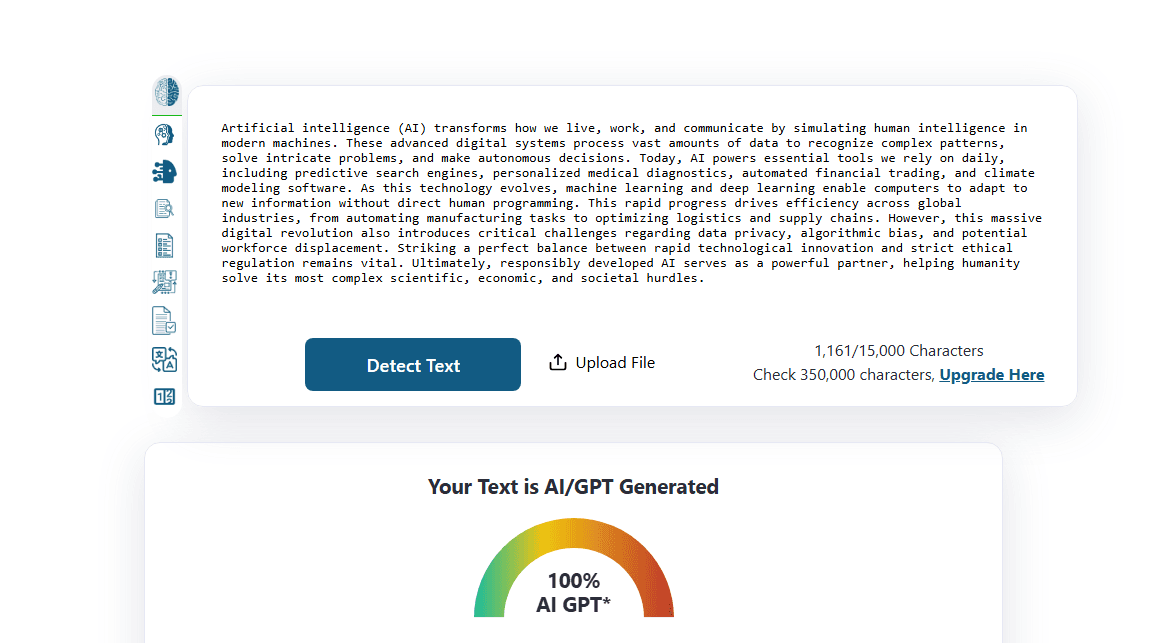
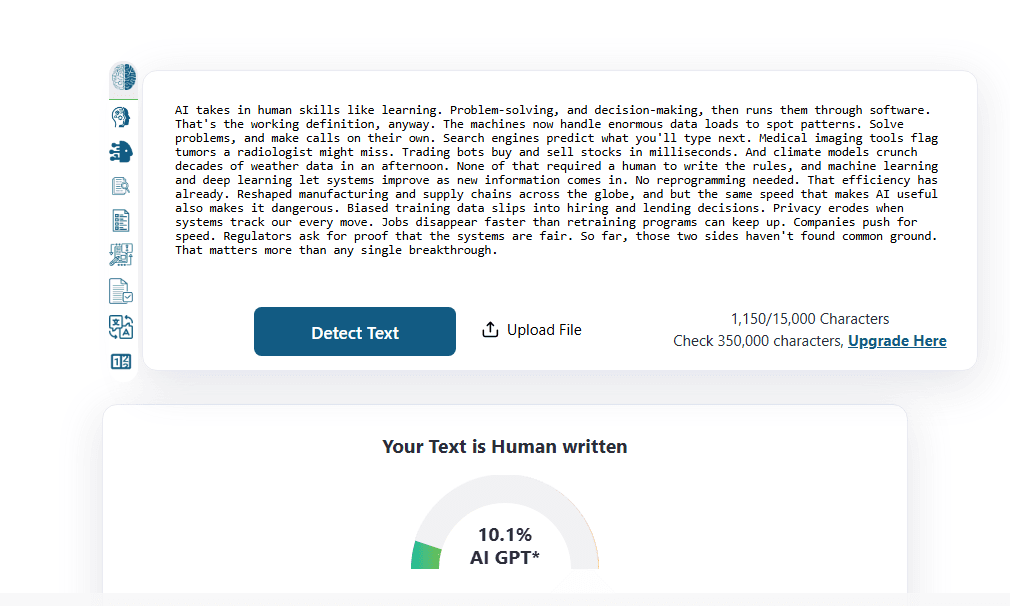
Next step: score AI writing tells, then run detect → humanize → publish, or read the proof case study.
Paste the draft you would publish, scan it locally for robotic tells (up to 8,000 characters, no credits), then rewrite only if the flag list is dense. The rewrite targets cadence and stock phrasing. You copy the output and review facts yourself.
Asking ChatGPT to “make it more human” usually returns another fluent paragraph with new filler. The scan names the tells first, so rewrite is optional.
Paste the draft you would publish (ChatGPT, Claude, Gemini, or mixed edits).
Run a local scan for AI writing flags — free, no credits.
Click Humanize to rewrite toward clear, direct, human rhythm under your AI credit budget.
Copy the cleaned output into your CMS, email, or docs — then human-review facts.
| Mode | What it does | Credits |
|---|---|---|
| Scan | Flags stock phrases, em dashes, and flat cadence locally | None |
| Humanize | Rewrites toward clear, direct, human rhythm | Yes — monthly AI credits |
AI writing often sounds robotic because it repeats stock openers, leans on em dashes, keeps every sentence the same length, and hedges with vague claims instead of names, numbers, or tradeoffs. Fluency is not the same as a point of view. Those tells are what this page scans for.
A high flag count means the draft matches common machine patterns. It is not proof of which model wrote it. Cleaning style will not hide plagiarism or fake citations.
Paste the ChatGPT draft you would actually publish, scan for robotic tells, and rewrite only if flags are dense. Then add one detail the model cannot know — a constraint, a date, a failed experiment — and check names, numbers, and links. Cadence is not accuracy.
Synonym-swapping is not the job. If the draft has nothing specific in it, a rewrite will still sound generic. Edit by hand when flags are sparse.
OmniKit humanizes cadence, not a protected-phrase lock. Paste the draft with the ranking terms you already use, scan robotic tells for free, then rewrite only if flags are dense. After the pass, restore any target keywords, headings, or internal anchors that moved, and finish title, meta, and SERP preview.
Competing “keyword shield” tools lock strings before rewrite. OmniKit’s job is stock phrasing and rhythm. For SEO pages, treat the rewrite as a body pass, then verify the primary query still appears naturally — not stuffed in every sentence.
No. OmniKit’s AI content humanizer is a style tool. It is not built to evade school, publisher, or commercial AI detectors, and it does not claim to. Third-party scores can move after a rewrite and still be wrong — they are heuristics, not authorship certificates.
If your goal is to hide AI use from an institution or client that forbids it, do not use this product for that. If your goal is clearer marketing or operator copy, scan, humanize cadence, then own the facts.
Match tone to search intent when you humanize web copy. Informational pages stay informative and conversational with clear subheadings and bullets. Commercial pages stay experiential and objective with comparisons and pros/cons. Transactional pages stay action-oriented and direct with CTAs and numbered lists.
Yes. An AI humanizer clears robotic rhythm when you already know what the piece should say. Manual editing is how you add judgment, experience, and facts. Use the tool for cadence. Keep the human pass for anything you would defend in a meeting.
Pages built only to rank, with no first-hand detail, still fail Google’s people-first test — whether a humanizer touched them or not. Asking ChatGPT to “make it human” usually produces new filler, not a named example.
Paste the AI draft, run the free tell-scan, then Humanize only if flags are dense. Add one lived detail and fact-check before publish. The tool improves cadence; it does not verify facts or bypass detectors.
An AI content humanizer rewrites AI-generated text to reduce repetitive phrasing, unnatural sentence patterns, generic wording, and other characteristics that make writing sound machine-generated. It improves cadence. It does not verify facts or bypass detectors.
Yes. Humanise is the UK spelling; humanize is US. Same job: make AI writing sound like a person wrote it. This tool keeps the spelling already in your draft.
Paste the ChatGPT draft, scan for tells, then run Humanize only if flags are dense. Edit specifics and facts yourself before publish — the tool improves tone and rhythm, not accuracy.
It rewrites robotic cadence around the meaning of the draft; it does not auto-lock every keyword like a phrase shield. Keep target terms in the paste, scan first, then restore any ranking phrases that moved. Finish with Title CTR Scorer, Meta Description Rewriter, and SERP Snippet Preview.
Scanning for robotic tells is free. Rewrites start with 15,000 guest credits and no account. A free registered plan is 30,000 credits per UTC month. Scan never spends credits.
No. The tell-scan runs in the browser and does not use an API key or credits. Rewrites use OmniKit AI credits and need remaining budget.
No. OmniKit improves readability and tone. It is not a detector-evasion, academic cheating, or watermark-removal tool. Style scores from third-party detectors vary and are not what this product optimizes for.
No. Detector scores are heuristics. They can drop after a rewrite and still be wrong. Use OmniKit to clear robotic cadence, then fact-check — do not treat any score as proof of authorship.
You get a structured scan of specific tells, then an optional rewrite — plus a path into Brand Voice, detector, and SERP preview tools. ChatGPT usually returns another fluent paragraph with new filler.
Yes. OmniKit — AI Content Humanizer is a separate Chrome extension: free local scan in the side panel, optional rewrite with credits. Chrome Web Store: https://chromewebstore.google.com/detail/fpbadhabkldaihpdemkgfediijicmfmg. Hub: https://omnikitapp.net/extension.
Scan the draft, check brand voice, preview the SERP snippet, or open the how-to playbook after you rewrite.
Use this page when you need to humanize AI text and the draft still sounds machine-made. Scan first. Rewrite if the flags pile up. Then put back what a model cannot invent: a named example, a number you measured, a tradeoff you would defend. Prefer Chrome? The OmniKit extension runs the same scan + rewrite in a side panel — see /extension.
Longer playbooks live on how to humanize AI content.